Built to be handed to someone else.
A full professional console your programmer carries, so there is nothing to rent, truck or park beside the camera.
The person who programs it is rarely the person running it on Sunday, and the tech director decides how much of the console the room ever sees. Share the file with the next campus or the next director and every room runs the same service. It arrives as a subscription rather than a capital request, which is a different conversation with a different committee.
- check_circleServices in one room or five
- check_circleChristmas and Easter
- check_circleTeams that hand over every week
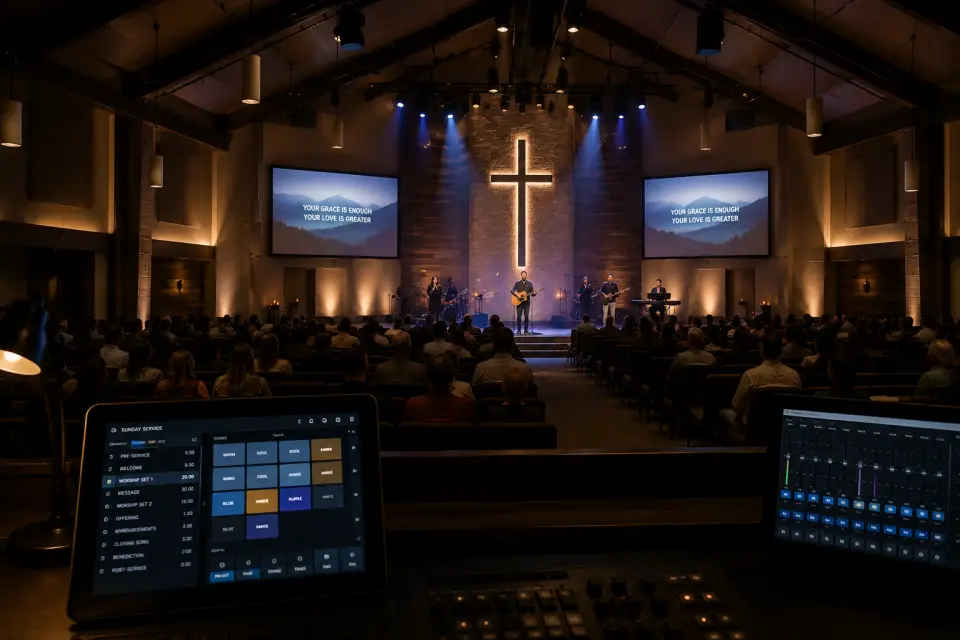
Sample “I set it up on Thursday. Sunday morning it is four buttons.”
Things you've paid extra for before.
Every one of these is a line on somebody's invoice or an hour on somebody's clock. This is how they go in houses of worship.
A volunteer is running Sunday.add
The service order becomes a row of labelled macros: worship, message, response, dismissal. A first-time operator taps through it. The lead tech doesn't get called in on a Saturday to lay anything out.
check_circleHanded over. Nobody called in.Christmas needs pixel mapping once a year.add
Putting a rental order in for one weekend a year is how most rooms do it. Pixel mapping is already in the console you already run the rest of the year, so the special service is a showfile, not a rental.
check_circleNo seasonal media-server rental.The booth is at the back. The stage is not.add
Focusing from the booth means a radio, someone relaying at the stage and a lot of guessing. Whoever is programming walks the stage with the console and the room follows.
check_circleFocus from the stage, not the back wall.The line items that go away.
- 01The rentalConsole rental + the cart
The console is already in your programmer's bag
A month of Core costs less than the first hour of your day. Month-to-month or annual.
- 02The cable runTwo days of pre-rig before anyone walks in
The pre-rig was two days. Now it's the walk to set.
A wired rig gets built days early: DMX up the block, Ethernet runs to every floor, wireless hops bridging the gaps you could not pull cable through. Then someone wants the other direction and all of it comes back out. Blackout plus a Cerise puts the rig on CRMX: patch in minutes, from wherever you are standing, and when the shot flips you just shoot it. sACN and Art-Net over Wi-Fi or Ethernet when you do want the wire.
- 03The ramp-upSix months before anyone trusts you on the desk
Months on a big desk. One afternoon on Blackout.
Full-size consoles are built to be mastered, not learned. Programmers count that ramp in months, and the syntax doesn't transfer to the next brand anyway. Blackout's layout never moves, and every verified profile has been driven against its DMX chart before it ships, so patch takes minutes and the surprises don't show up at 2am.
- 04The note round-tripHow a note used to landDP: Can we take the practical down a hair? Gaffer: Copy. (into walkie) Jim, go down 10 points on the left practical. Board op (two blocks away, in a truck): Say again? Gaffer: Ten points! Left practical! Board op: …Which one's the left practical? (the unit stands by)How it lands nowDP: Can we take the practical down a hair… (it's already down)
Your programmer is at the monitor with the console in hand. Free LivePlot viewers put the rig on the DP's and gaffer's own screens: live data, not a plot, every fixture showing the intensity, color and position it is at right now, changing as it changes. Half those notes never get said in the first place.
Argue with the numbers.
Every field is editable. Put in what your production actually pays and see what an iPad console changes.
Your production
Pays for itself before day one, on the pre-rig alone.
- Console rental avoided$200 × 52 days$10,400
- Pre-rig days avoided2 days × 2 crew × $650$2,600
- Setup & patch time saved67 min/day × 52 = 58.1 h at $15/h$871
- Tweak time saved on set5 min × 4 setups/day × 52 = 17.3 h$260
- Your Core subscription12 months × $24.99, annual rate−$300
Send it to yourself, or to whoever signs off on the budget. Start with a free 14-day trial on any plan.
calculateHow we calculate this expand_more
Console rental avoided: rental per day × production days. The one line nobody argues with.
Pre-rig days avoided: pre-rig days × crew × crew day rate. Wireless DMX means the cable run doesn't get built, so the days spent building it don't get worked.
Setup & patch time saved: (90 − 23) min per production day, valued at the day rate over a 10-hour day.
Tweak time saved on set: the minutes per lighting setup, the round trip from note to desk to unit, at the same hourly.
Subscription: your plan's effective monthly: one month at the monthly rate, twelve at the annual rate.
90 to 23 min and the per-setup minutes are placeholders until the timed head-to-head demos set them.
Estimate, not a quote. Every input is a fader and every line has a checkbox: turn off anything you don't buy and the total recalculates without it.
A console is only as good as its profiles.
Every cue, every color, every effect is built on the assumption that channel 14 does what the chart says it does. Get that wrong and nothing above it can be right.
On most consoles, fixing a bad profile lands on your programmer’s clock before a single cue exists.
The libraries you can license are built once, at scale, from paperwork, and the mistakes ship with them: wrong channel counts, missing modes, a profile that doesn’t match the light in front of you. The shared formats don’t rescue it either. A GDTF file only carries what the manufacturer put into it, errors included.
We tried to buy one. We licensed an industry library, went through it, and found too much of it wrong to patch. So we threw it out and rebuilt every profile by hand.
40,000+ profiles, human-verified. Built in-house, not licensed, updated daily, and new ones typically land within hours of a spec sheet. It is the largest human-verified fixture library in lighting and it lives inside the console.
Verified profiles.
A verified profile has been tested working on the fixture itself, not just checked against the manufacturer’s chart. Patch one and every channel does what it says.
Missing a profile? Ask for it.
Request it in the help center. New profiles are built by hand and typically land within hours of a spec sheet.
Request a profilearrow_forwardUsed by professionals in 90+ countries.
Designed by a Local 52 lighting programmer, from the ground up, for the fixtures crews use every day.
Hire someone who already knows it.
The Lighting Pro Directory lists verified Blackout programmers, local gear, and trainers for your team.
Deploying across a fleet?
Per-device licensing on Advanced, Pro or Command with a 3-device minimum: central admin, central billing, instant org-wide revocation, priority support.