Decide exactly how much of it Sunday sees.
A full console, built for the person with hands on it. Everything below is the spec sheet.
A PIN lock with your own lock screen, and the surface behind it is whatever the tech director chose, including Stream Deck keys they drew themselves, foot pedal included. Notes sit beside each look so the operator reads what happens next instead of remembering it. Put macros on the buttons rather than raw looks, because a raw look tap snaps.
Stage, cyc and house, the same rig every week, in one room or in five.
- check_circlePIN lock with your own lock screen
- check_circleStream Deck keys the tech director drew, foot pedal included
- check_circleNotes the operator reads beside each look
- check_circleMacros on the buttons, because a raw look tap snaps
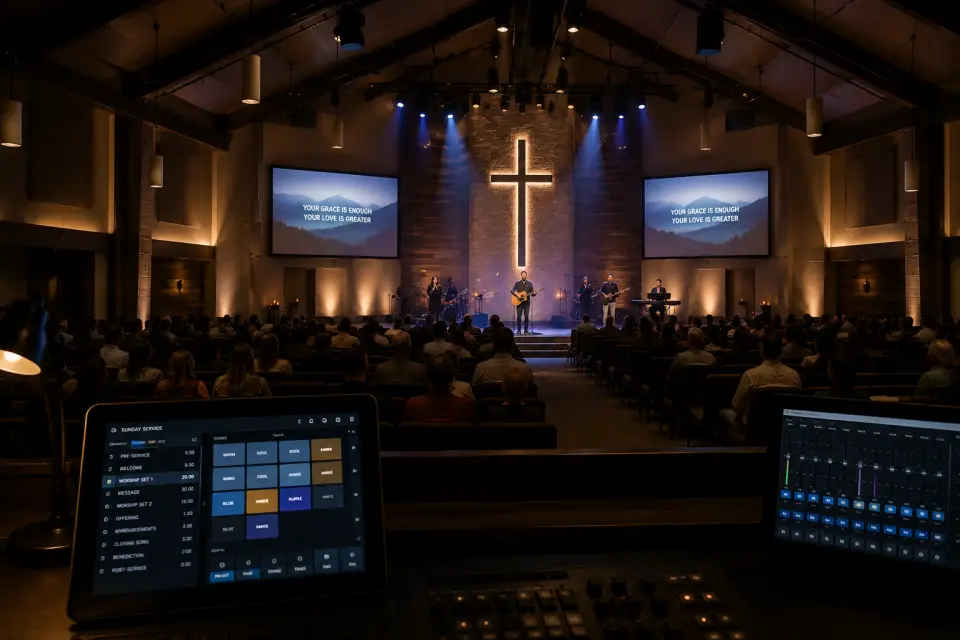
How it actually runs.
preset the service order
a volunteer taps through the looks
stream-friendly looks preset in advance
duplicate, add specials
feature-fadersfeature-pixelmapfeature-patchEverything a desk does. None of the setting-up.
feature-liveplotfeature-fixture_controlsfeature-fadersTalks to what's already on your truck.
- ethernetsACNOut over Wi-Fi or Ethernet, to any node
- ethernetArt-NetOut over Wi-Fi or Ethernet, to any node
- DMX inMerge, monitor and trigger from any desk
- cableOSCCue and parameter control from any app or desk
- midiMIDITimecode, controllers, encoders





- castNDI®Video into the pixel map, with WHIP, RTMP, SRT, SRT pull and RTSP inputs too (Pro+)
- paletteACESColor-managed pipeline (Command)
- tunePer-fixture color trimsTrim the color of each fixture on its own, for the unit that always runs warm (Command)
NDI® is a registered trademark of Vizrt NDI AB.
Every tool in the console.
feature-patchfeature-fixture_controlsfeature-effectsfeature-fadersFive actions. One finger. Always the same place.
Press and hold any effect, group, look, favorite or macro and the HUD opens under your finger. Edit, Rename, Clone, Move, Delete. Six slots, five actions, and the bottom one left empty so your finger never covers what you are reaching for.
The smallest details carry the most weight here. Actions that don’t apply dim where they sit instead of disappearing, so the shape never changes and your finger stops hunting for it.
A console is only as good as its profiles.
Every cue, every color, every effect is built on the assumption that channel 14 does what the chart says it does. Get that wrong and nothing above it can be right.
On most consoles, fixing a bad profile lands on your programmer’s clock before a single cue exists.
The libraries you can license are built once, at scale, from paperwork, and the mistakes ship with them: wrong channel counts, missing modes, a profile that doesn’t match the light in front of you. The shared formats don’t rescue it either. A GDTF file only carries what the manufacturer put into it, errors included.
We tried to buy one. We licensed an industry library, went through it, and found too much of it wrong to patch. So we threw it out and rebuilt every profile by hand.
40,000+ profiles, human-verified. Built in-house, not licensed, updated daily, and new ones typically land within hours of a spec sheet. It is the largest human-verified fixture library in lighting and it lives inside the console.
Verified profiles.
A verified profile has been tested working on the fixture itself, not just checked against the manufacturer’s chart. Patch one and every channel does what it says.
Missing a profile? Ask for it.
Request it in the help center. New profiles are built by hand and typically land within hours of a spec sheet.
Request a profilearrow_forwardFour tiers, 2U to Uncapped.
Core, Advanced, Pro, Command. Compare every gate side by side.
From DMX basics to timecode.
Free tutorials by the people who built it, and live sessions for your team.
Build your rig.
Answer a few questions and the rig draws itself, with every cable between the boxes.
Get listed on the map.
Producers and DPs search the Lighting Pro Directory for programmers who know Blackout. Your profile is free.